
Gong Cha Origins: Kaohsiung Bubble Tea Itinerary
Disclosure: To help support our website, some of the links below are affiliate links. This means that if you choose to make a purchase, we will earn a commission at no additional cost to you.
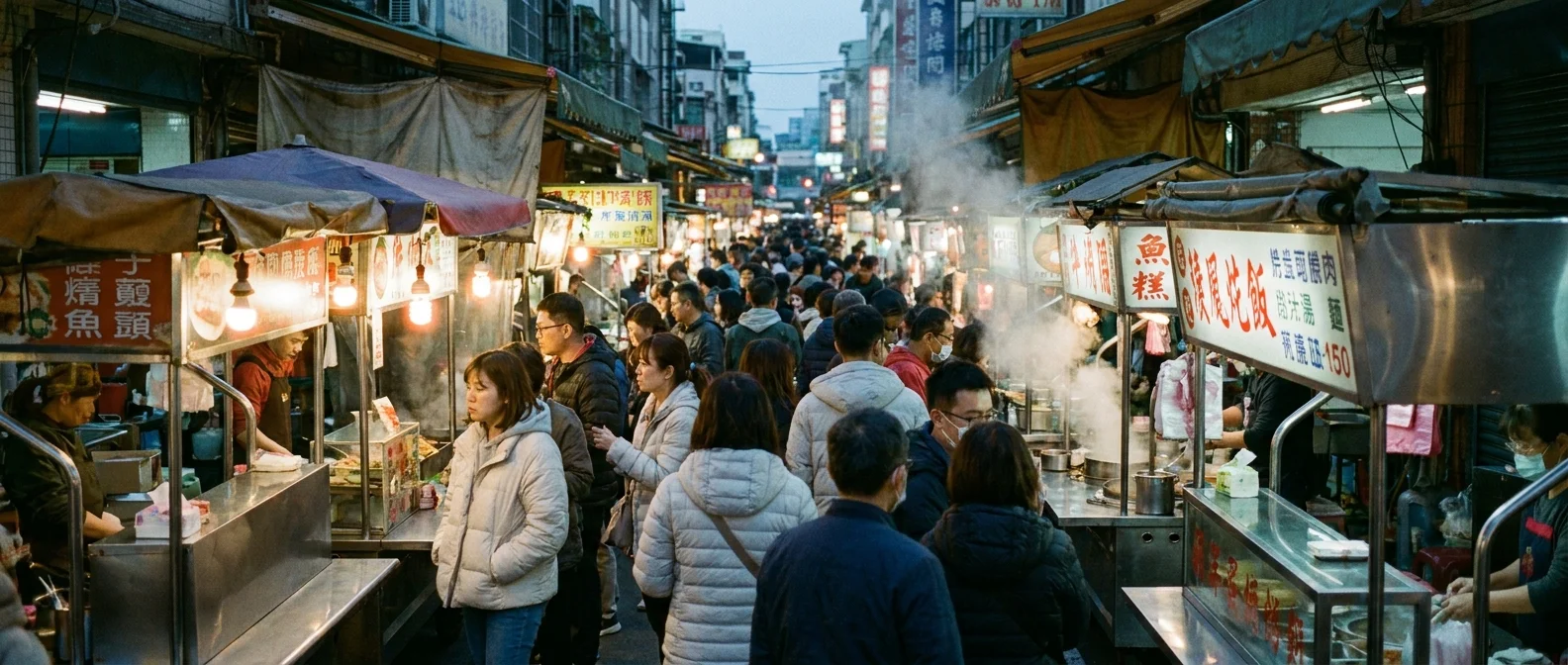
Table Of Contents
- Quick Answer
- Kaohsiung winter food guide: Planning at a glance
- The Bubble Tea Pilgrimage: Zuoying District Travel
- The Night Market Showdown: Ruifeng vs. Liuhe
- Beyond the Neon: Yancheng and Lingya Districts
- Transit Mechanics: KMRT, LRT, and IC Cards
- Weather Realities: What to Wear in Kaohsiung Winter
- Mistakes First-Timers Make
- Related FAQs
- Closing
As the viral Gong Cha bottled-drink trend sweeps social media, a new wave of Gen Z and Millennial foodies is looking beyond the plastic seal to discover the source of Taiwan’s famous tea culture: Kaohsiung. This southern port city offers much more than popular tea franchises; it blends traditional tea-making, refreshing milk teas, local snacks, and a vibrant night-market food scene. Kaohsiung bubble tea deserves a place on every food lover’s itinerary, with opportunities to explore creamy milk tea, chewy tapioca pearls, fruit-infused drinks, and locally inspired flavors.
During winter, cooler temperatures make it easier to wander through bustling streets and sample different drinks alongside traditional Taiwanese small eats, known as xiaochi. This Kaohsiung winter food guide takes you through the lively Zuoying and Yancheng districts, where independent tea shops, street-food stalls, and neon-lit markets offer a taste of everyday local life. You’ll discover what to order, how to customize sugar and ice levels, and how to choose drinks that suit your preferences. We’ll also share practical tips for navigating popular night markets, understanding unfamiliar menus, and avoiding peak crowds. Whether you’re a dedicated bubble tea fan or a first-time visitor to southern Taiwan, this guide will help you explore Kaohsiung’s tea culture and winter food scene with confidence.
Quick Answer
- Best Window: November to early January offers the “Goldilocks” climate: dry, clear skies and temperatures between 18°C and 25°C (64°F to 77°F).
- Expected Conditions: Negligible rainfall and low humidity: a rare Mediterranean-style comfort in a typically tropical zone.
- The Main Friction: 95% of street food stalls are cash-only; Ruifeng Night Market is closed on Mondays and Wednesdays.
- Booking Note: Avoid the final week of January (Lunar New Year) unless you book hotels six months in advance and enjoy extreme crowds.
Kaohsiung winter food guide: Planning at a glance
| Month | Avg. Daytime Temp | Crowd Level | Best For |
|---|---|---|---|
| November | 26°C (79°F) | Moderate | Outdoor festivals and exploring the Pier-2 Art Center. |
| December | 23°C (73°F) | Moderate | Peak dry season comfort and night market hopping. |
| January | 22°C (72°F) | High (Late Jan) | Traditional Lunar New Year snacks: but expect price spikes. |
The Bubble Tea Pilgrimage: Zuoying District Travel
Kaohsiung bubble tea culture did not begin as a global franchise; it started as a localized obsession with tea quality and milk foam textures in the 1980s. While Taipei often takes the credit for Taiwan’s tea innovations, Kaohsiung is where the “Milk Cap” (Mustache Tea) was popularized by Gong Cha. The original flagship, though modernized, remains a point of interest for those tracking the brand’s evolution. Beyond the franchise, the city’s tea scene is defined by a preference for Alisan Oolong and Winter Melon Tea, the latter being a regional specialty that uses smoked wax gourd to create a caramel-like sweetness without the need for refined syrups.
When engaging in Zuoying district travel, your primary hub is the Kaohsiung Arena Station on the KMRT Red Line. From Exit 1, it is a five-minute walk to the dense cluster of tea shops that surround the Hanshin Arena Shopping Plaza. Here, you can find high-end teahouses like Chun Shui Tang, which many locals consider the true creator of the pearl milk tea concept. If you plan to visit Chun Shui Tang on a Saturday or Sunday, reservations are recommended as wait times for a table can exceed 60 minutes.
The Zuoying district also serves as the gateway for travelers arriving via the High-Speed Rail (HSR) at Zuoying Station. This area represents the modern face of Kaohsiung, where wide boulevards and high-rise apartments house the city’s most competitive tea brands. When ordering, look for regional variations such as “Tieguanyin Milk Tea” with a “Milk Foam” topping. In Kaohsiung, the foam is often saltier and thicker than what is served in North American or European outlets, designed to balance the intense sweetness of the southern tea blends.
The Night Market Showdown: Ruifeng vs. Liuhe
The logistical heart of any Kaohsiung travel itinerary is the night market. However, the two primary options offer vastly different experiences. Ruifeng Night Market, located in the northern Zuoying district near the Kaohsiung Arena, is the undisputed local favorite. Unlike the linear street markets found in Taipei, Ruifeng is a square grid of high-density stalls. It is famous for Ruifeng night market food staples like “Angel Fried Chicken” (Tian Shi Zhi Pai), a thick-cut, juice-heavy chicken steak that often commands a 30-minute queue. Expect to pay approximately 100 TWD (3.15 USD) for a portion large enough to share.
Liuhe Night Market, situated at the Formosa Boulevard KMRT station, is the “tourist gateway.” While some locals dismiss it as being too geared toward visitors, it offers more physical space and seating than Ruifeng. It is the best place to try “Zheng Lao Pai Papaya Milk” (60 TWD / 1.90 USD), a stall that has been operating for over 50 years and is recognizable by the signatures of famous visitors covering its signage. A critical warning for Liuhe: be wary of fruit stalls that do not list prices clearly. Always ask for the price per 600 grams (one “jin”) before ordering to avoid the “fruit scam” where visitors are overcharged for pre-cut wax apples or mangoes.
The most important logistical detail for Ruifeng is its schedule: it is closed every Monday and Wednesday. On these nights, the area is dark, and the crowds migrate to smaller, neighborhood markets. If your schedule only allows for a Monday visit, you must pivot to Liuhe or the Guanghua Night Market in the Lingya District.
Timing and crowd strategy
To experience Taiwan winter street food without the crushing physical contact of peak hours, aim for the 6:00 PM to 7:30 PM “sweet spot.” Most stalls are fully operational by 6:00 PM, but the heavy dinner rush of local students and office workers does not arrive until 8:00 PM. On Saturday nights, Ruifeng becomes so congested that the aisles move at a “shuffle” pace: if you are claustrophobic, Saturdays are to be avoided entirely.
A reliable quality indicator in any Kaohsiung market is the length of the line for “QQ Balls” (sweet potato balls). These deep-fried spheres should be airy and crisp. If a line is long, it means the stall is frying them fresh in small batches rather than letting them sit under a heat lamp.
How to order street food in Taiwan
Understanding how to order street food in Taiwan requires a basic grasp of the “point and pay” system. Most stalls have menus with pictures or English translations, but many smaller vendors in Ruifeng use Traditional Chinese clipboards. If you do not speak the language, pointing at the physical ingredients or a photo on your phone is perfectly acceptable.
Payment is almost exclusively cash. While some larger stalls have begun accepting LINE Pay, the majority of the “Xiaochi” vendors require coins or small bills. Southern Taiwanese food is notoriously sweeter than northern food: sugar was historically a status symbol in this region due to the proximity to sugar cane refineries. When ordering bubble tea, specify your sugar level: “Ban-tang” (half sugar) or “Wei-tang” (quarter sugar) is generally the sweet spot for international palates used to less intense syrup levels.
Beyond the Neon: Yancheng and Lingya Districts
To complete a Kaohsiung travel itinerary, you must move south into the Yancheng District. This is the “Old Soul” of the city, characterized by narrow shophouses and a slower pace of life. Yancheng is home to “Gangyuan Beef Noodles,” a legendary establishment where the broth is rich and the noodles are hand-pulled. A bowl here costs roughly 120 to 150 TWD (3.80 to 4.75 USD).
For those seeking a “foodie secret” zone, the Lingya District offers the Zhongxiao and Guanghua night markets. These are “street-side” markets where stalls line the actual road rather than a dedicated lot. This is where you find the best Eel Braised Noodles (Shan Yu Yi Mian), a southern specialty where the eel is flash-fried in a sweet and sour brown sauce.
Navigating these districts is most efficient using YouBike 2.0, the city’s bike-sharing system. There are docking stations every few blocks in Yancheng and Lingya. The cost is approximately 10 TWD (0.30 USD) for every 30 minutes. It allows you to hop between stalls that are too far apart to walk but too close to justify a KMRT ride. If you have extra time, take the KMRT Orange Line to the Fengshan District to find “Rice Tube Pudding” (Tong Zai Mi Gao), a savory steamed glutinous rice dish topped with pork floss and cucumber.
Transit Mechanics: KMRT, LRT, and IC Cards
Kaohsiung’s public transit is exceptionally reliable and clean. The system consists of the Red Line (North-South), the Orange Line (East-West), and the circular LRT (Light Rail Transit) that loops around the harbor.
The primary tool for any traveler is an IC card, either the “iPass” (which originated in Kaohsiung) or the “EasyCard” (from Taipei). Both work interchangeably on all KMRT lines, the LRT, buses, and even the ferry to Cijin Island. You can purchase these at any 7-Eleven or FamilyMart for 100 TWD (non-refundable) and top them up with cash at the same counters or at KMRT station kiosks.
There are two common transit traps for first-timers. First is the “LRT Tapping” rule: unlike the KMRT, there are no turnstiles for the Light Rail. You must tap your card at the validator on the station platform before boarding AND after exiting. Failure to tap out will result in your card being locked, requiring a visit to a service center to fix. Second is the “Bus Boarding” rule: in Kaohsiung, you must tap your card both when you enter the bus and when you exit.
The KMRT Red Line connects directly to Kaohsiung International Airport (KHH). The ride from the airport to the central hub at Formosa Boulevard takes approximately 15 minutes and costs 30 TWD (0.95 USD). This makes Kaohsiung one of the most accessible cities in Asia for a short-term food pilgrimage.
Weather Realities: What to Wear in Kaohsiung Winter
Understanding what to wear in Kaohsiung winter is about managing 10°C (18°F) temperature swings. While the daytime can feel like a mild summer day at 25°C, the temperature drops quickly once the sun sets around 5:30 PM. The sea breeze coming off the Love River and the Kaohsiung Harbor adds a chill that can make 16°C feel significantly colder.
Layering is the only effective strategy. A heavy winter coat is unnecessary and will be a burden to carry during the day. Instead, pack “heat-tech” or lightweight merino wool base layers that can be worn under a T-shirt or light sweater. A lightweight windbreaker or a packable down vest is ideal for evening night market runs.
Winter is the dry season for southern Taiwan, meaning you will likely experience clear blue skies for the duration of your trip. However, the coastal winds can occasionally bring a fine mist. Comfortable walking shoes are the most critical item in your luggage: expect to clock 15,000 to 20,000 steps per day as you navigate the long aisles of Ruifeng and the art installations of the Pier-2 Art Center.
Mistakes First-Timers Make
- The Trash Trap: Expecting public trash cans on every corner. Public bins are rare in Taiwan to encourage waste reduction. The Fix: Carry your own small waste bag. Night market stalls will generally only take back the trash from the specific items they sold you.
- The LRT Ghost Penalty: Failing to tap out on the platform validator. If you forget to tap your iPass at the station pillar after exiting the light rail car, your card will be flagged. The Fix: Always tap your card at the platform, not just inside the train.
- The Sweetness Shock: Ordering “Full Sugar” in Kaohsiung. Southern Taiwan tea is significantly sweeter than Taipei’s. The Fix: Order “Half Sugar” (Ban-tang) or “Quarter Sugar” (Wei-tang) to match Western taste preferences.
- The Monday Ruifeng Run: Arriving at Ruifeng on a Monday or Wednesday. The market is dark on these days. The Fix: Pivot to Liuhe Night Market or the Guanghua Night Market on these specific days to avoid disappointment.
Related FAQs
Ruifeng is superior for food variety, local atmosphere, and trendy snacks, but it is very crowded. Liuhe is better if you want more space, sit-down seafood options, and a more relaxed pace, though it is more tourist-centric.
Tap water in Taiwan is generally not recommended for direct consumption. Most hotels provide water dispensers or bottled water. Boiling tap water is common, but using the filtered dispensers found in most public areas and KMRT stations is the safest and most sustainable option.
While daytime highs reach 25°C, nighttime lows can drop to 14°C (57°F). Because the humidity is low, it feels like a “dry cold” that can be surprisingly biting when the wind picks up near the harbor or the Love River.
No. Taiwan has a zero-tipping culture. Attempting to tip at a night market stall or a restaurant may confuse or be politely refused. The price listed is exactly what you are expected to pay.
Cash is the primary currency for 95% of stalls. While some modern vendors in Ruifeng may accept LINE Pay or iPass, you should always carry 100 TWD and 500 TWD notes to ensure you can purchase from any vendor.
The pungent aroma comes from the fermentation process of the tofu. To locals, a stronger smell often indicates a higher quality, more traditional fermentation. It is a staple of the night market experience and is usually served deep-fried with pickled cabbage.
Closing
With your iPass topped up and your “Half-Sugar” boba in hand, you are ready to navigate the most flavorful winter destination in East Asia. Just remember to keep your crossbody bag close and your appetite open for the Angel Fried Chicken. Your next step is to check the KMRT Red Line schedule and head straight from the airport to Formosa Boulevard to begin the pilgrimage. Verify all stall operating hours locally before travel, as seasonal shifts can occasionally alter the night market landscape.

As the viral Gong Cha bottled-drink trend sweeps social media, a new wave of Gen Z and Millennial foodies is looking beyond the plastic seal to discover the source of Taiwan’s famous tea culture: Kaohsiung. This southern port city offers much more than popular tea franchises; it blends traditional tea-making, refreshing milk teas, local snacks, […]
Mexico City (CDMX) is undergoing a cultural renaissance, fueled by the viral “Viva México” trend that has turned the city from a stopover into a top destination. For first-timers, the window between November and February is the “sweet spot”: a period of “Eternal Spring” that avoids the torrential summer rains. This Mexico City winter travel […]

Every autumn, the internet erupts into a frenzy over the residents of Brooks River as Fat Bear Week 2027 brings global attention to Katmai National Park’s famous brown bears. However, for travelers who want to witness these incredible animals in person, the journey requires careful planning well before the competition begins. This Katmai bear-watching travel […]