
Seoul Autumn Travel Tips: Foliage Timing & Weather
Disclosure: To help support our website, some of the links below are affiliate links. This means that if you choose to make a purchase, we will earn a commission at no additional cost to you.
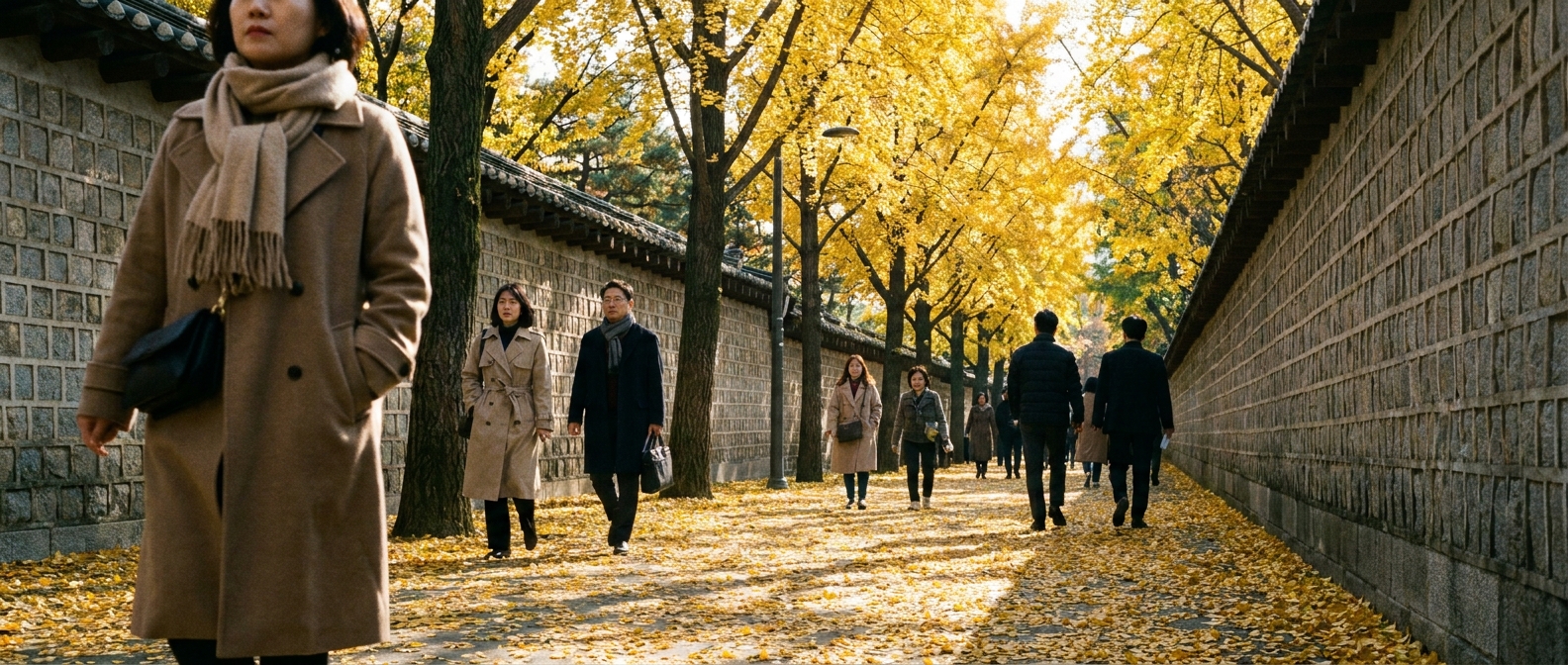
Table Of Contents
- Quick Answer
- Timing the "Danpung" Peak and Palace Protocols
- Neighborhood Guide: Where to Base Your Foliage Chase
- Transit Mechanics: T-Money, Climate Cards, and Navigation
- Weather Survival: Managing the "Sun-Down Shiver"
- Money, Etiquette, and Safety for the Solo Traveler
- Practical Logistics and Packing
- Mistakes First-Timers Make
- Related FAQs
- Final Thought
Seoul transforms into a canvas of fiery maples, crimson foliage, and golden ginkgo trees during the “Danpung” season. These Seoul Autumn Travel Tips help you choose the right time to visit, catch the peak fall colors, and prepare for sudden November cold snaps. The city’s parks, palace grounds, mountain trails, and traditional neighborhoods take on a completely different character as autumn colors spread across the capital. Temperatures can change quickly throughout the day, so smart planning matters when you spend hours exploring outdoor attractions.
This guide provides a practical breakdown of foliage timing, palace logistics, transportation, walking routes, and weather management. You can plan your days around the best seasonal views while avoiding unnecessary crowds and last-minute travel problems. Prepare the right layers, check the forecast before heading out, and allow extra time for popular attractions and busy transport routes.
From early-morning palace visits to peaceful afternoon walks beneath colorful ginkgo trees, timing can significantly improve your experience. By combining weather planning with flexible sightseeing schedules, you can explore Seoul’s autumn highlights comfortably and make the most of the city’s short but spectacular foliage season.
Quick Answer
- The Peak Window: The last week of October through the first week of November is the ideal time for peak foliage.
- The Weather Reality: Expect 18°C (64°F) afternoons dropping rapidly to 2°C (35°F) after sunset; layering is mandatory.
- The Main Friction: Secret Garden (Huwon) tickets at Changdeokgung sell out in minutes; you must book exactly 6 days in advance.
- Booking Note: Use the Korea Climate Card for tourists for unlimited transit if staying 1 to 5 days within Seoul city limits.
| Month | Daytime High | Nighttime Low | Crowd Level | Best For |
| Early October | 20°C (68°F) | 10°C (50°F) | Moderate | Mild hiking & outdoor festivals |
| Late October | 15°C (59°F) | 7°C (45°F) | Peak | Peak foliage photography |
| Early November | 12°C (54°F) | 2°C (36°F) | High | Late-season colors & crisp skies |
| Late November | 8°C (46°F) | -2°C (28°F) | Low | Winter illuminations |
Timing the "Danpung" Peak and Palace Protocols
The autumn foliage season, known as Danpung, is not a single event but a wave that moves from the northern mountains down into the city center. In Seoul, the transformation typically begins in mid-October on Bukhansan Mountain and reaches the city palaces between October 25 and November 5. Ginkgo trees usually turn golden a few days before the maples reach their deepest reds.
The Secret Garden (Huwon) within Changdeokgung Palace is the most sought-after foliage spot in the country. Access is strictly limited to guided tours, and tickets are notoriously difficult to secure. Reservations open at 10:00 AM Korean Standard Time exactly 6 days before the tour date. During the peak window, these tickets often vanish within three to five minutes. You must create an account on the official palace website in advance and be logged in with your payment details ready the second the clock strikes ten. If you fail to get a ticket, a very small number of walk-in tickets are sold at the gate starting at 9:00 AM, but queues for these often begin at 7:30 AM.
Palace pacing requires knowledge of the weekly closure schedule. Gyeongbokgung, the largest palace, is closed every Tuesday. Changdeokgung, Deoksugung, and Changgyeonggung are closed every Monday. Planning your itinerary without checking these dates often leads to a wasted trip to the Jongno-gu district. If you want to photograph the Royal Guard Changing Ceremony at Gyeongbokgung without thousands of other tourists in your frame, avoid the 10:00 AM and 2:00 PM time slots. Instead, visit the Gwanghwamun Gate at 11:00 AM or 1:00 PM when the crowds have dispersed but the architectural scale remains.
For those seeking the best Seoul autumn travel tips regarding photography, the stone-wall walkway (Deoksugung Doldam-gil) next to Deoksugung Palace offers a concentrated burst of yellow ginkgo leaves. It is a 5-minute walk from City Hall Station (Line 1, Exit 2). Arrive before 8:30 AM on a weekday to capture the path before the nearby office workers emerge for their lunch breaks between 11:30 AM and 1:30 PM.
Mastering Sub-Zero Photography in Tromsø.
Neighborhood Guide: Where to Base Your Foliage Chase
Choosing where to stay in Seoul during autumn depends on your tolerance for crowds and your interest in traditional versus modern aesthetics. Jongno-gu is the historical heart of the city and the most strategic base for foliage chasers. Staying here puts you within a 15-minute walk of Bukchon Hanok Village and three major palaces. The downside is that the narrow alleys of Ikseon-dong and Bukchon become extremely congested between 1:00 PM and 5:00 PM, making movement slow.
Myeong-dong is the most popular choice for first-time visitors due to its central location on Metro Line 4. It is the commercial hub of the city, filled with street food and international brands. From Myeong-dong Station, it is a 15-minute uphill walk to the Namsan Cable Car base station. However, the cable car queue can exceed 90 minutes on October weekends. If you stay here, you sacrifice quiet for convenience. It is one of the best neighborhoods to stay in Seoul if you plan on taking the 6015 Airport Limousine bus, which drops passengers at several points along the main road, sparing you from hauling luggage through subway transfers.
Seongsu-dong has emerged as the “Brooklyn” of Seoul. Located on the eastern side of Line 2, this former industrial area is now home to high-fashion flagship stores and renovated warehouse cafes. It offers a “New Retro” aesthetic that contrasts sharply with the traditional palaces. The neighborhood is less about foliage and more about the “pop-up” culture of Seoul. It is a 20-minute subway ride from the city center, making it a quieter but slightly more distant alternative.
Hongdae and Yeonnam-dong are the primary zones for younger travelers. Located in western Seoul, these neighborhoods are centered around Hongik University and are famous for busking and nightlife. The main advantage of staying here is the direct connection to Incheon Airport via the AREX All-Stop train, which takes approximately 55 minutes. Yeonnam-dong, specifically the Gyeongui Line Forest Park, provides a long, narrow stretch of trees and cafes that is perfect for a low-key autumn afternoon.
Accessibility note: Travelers with limited mobility should prioritize Myeong-dong or Gangnam, as these areas have newer infrastructure. Many older subway stations in Jongno-gu involve long staircases and elevators that are often tucked away in inconvenient corners. Download the Seoul Subway app and use the “Elevator-only” route filter to navigate these stations.
Transit Mechanics: T-Money, Climate Cards, and Navigation
Navigating the Seoul Metropolitan Subway is efficient but requires specific tools. The standard payment method is the T-Money card, a rechargeable IC card that costs 3,000 to 5,000 KRW. However, for tourists staying 1 to 5 days, the Korea Climate Card for tourists is often a better value. For 5,000 KRW (1 day) or 15,000 KRW (5 days), you get unlimited rides on Seoul-only subways and buses. Note that this card does not cover the AREX Express train or subways that go far outside the city limits into Gyeonggi-do.
A critical friction point in Seoul transit is the payment method. You cannot use a foreign credit card, Apple Pay, or Google Pay at the subway turnstiles. You must have physical cash to top up your T-Money or Climate Card at the machines inside the stations. While most convenience stores accept credit cards for the purchase of the card itself, the actual balance top-up is a cash-only transaction. Carry at least 20,000 KRW in small bills specifically for transit needs.
For navigation, Google Maps is largely useless in South Korea due to government security regulations regarding map data. It does not provide walking directions and its transit data is often delayed. You must download Naver Maps or KakaoMap. These are the gold standard for Seoul subway navigation apps. They provide real-time bus locations, which exit number is closest to your destination, and even which subway car door will put you closest to your transfer staircase.
Getting from Incheon Airport to the city offers two main choices. The AREX Express train runs non-stop to Seoul Station in 43 minutes for approximately 11,000 KRW. The Airport Limousine Bus 6015 goes to Myeong-dong for 17,000 KRW. While the bus is more expensive and subject to traffic, it is often the superior choice for those with heavy bags, as it eliminates the need to navigate the massive, multi-level Seoul Station with luggage.
Seoul’s subway stations are massive; a single transfer can involve 1km of walking through underground tunnels. This constant movement can lead to lower leg swelling and heavy legs that ruin evening plans. Using graduated compression socks can improve circulation during these long transit days, ensuring you have the energy to walk the evening street food markets.
Weather Survival: Managing the "Sun-Down Shiver"
The defining characteristic of Seoul’s autumn weather is the extreme diurnal temperature variation. In late October, you may experience a sunny 18°C (64°F) afternoon while walking through the wind-shielded alleys of Ikseon-dong. However, the moment the sun dips behind Bukhansan mountain or the skyscrapers of Central Seoul, the temperature plunges 10 degrees in less than an hour. By 7:00 PM, it is often 5°C (41°F) or lower.
This “Sun-Down Shiver” catches many travelers off-guard. They leave their hotel in a light sweater and find themselves shivering in a street food queue by dinner time. The dry air in Korea makes the cold feel sharper than the numbers suggest. While a heavy winter parka is unnecessary in early November, you need a versatile layering system. A windproof outer shell paired with a mid-layer is the standard local uniform.
When packing, consider what to wear in Korea in November based on activity levels. If you are hiking Namsan or Bukhansan, you will sweat during the ascent but freeze the moment you stop at the summit. The low humidity also means your skin and lips will crack quickly; local pharmacies (identified by a green “Yak” sign) sell high-quality balms, but bringing your own is more efficient.
The temperature drop can also have a secondary effect on your electronics. Using navigation and translation apps in 5°C weather causes smartphone batteries to drain significantly faster than in temperate conditions. If your phone dies, you lose access to your digital maps and the ability to use translation tools in a city where English signage can become sparse once you leave the main tourist tracks. Carrying a slim, high-capacity power bank is a mandatory safety measure for long days of foliage chasing.
Strasbourg Christmas Market Packing & Footwear Guide for cold-weather footwear and layering tips.
Money, Etiquette, and Safety for the Solo Traveler
Seoul is 95% cashless. From high-end department stores to tiny cafes in Seongsu-dong, you can pay with a major international credit card. However, the “Cashless Myth” can still trip you up. You need physical KRW for three specific things: transit card top-ups, small street food stalls (though many now take cards), and traditional markets like Gwangjang or Namdaemun. Keeping 50,000 KRW in your wallet is usually sufficient for a three-day window.
Subway social norms are strictly enforced by peer pressure. Do not sit in the designated seats for the elderly, disabled, or pregnant women, even if the train is completely empty. These seats are left vacant out of cultural respect. Additionally, talking loudly on the phone or with your travel companions is considered rude. You will notice that Seoul subways are remarkably quiet, even during rush hour. When using escalators, stand on the right and walk on the left.
Seoul is consistently ranked as one of the safest cities in the world, and it is common to see women walking alone or sitting in cafes late at night. However, be aware of “distraction scams” in Insadong and Myeong-dong. These usually involve well-dressed young people asking for directions or inviting you to a “traditional Korean cultural ceremony.” These are often recruitment fronts for local cults. Politely decline and keep walking.
Budget tip: For a cheap, high-quality meal, utilize the “Convenience Store Dinner.” Chains like GS25, CU, and 7-Eleven offer “Dosirak” (lunch boxes) for 4,000 to 6,000 KRW. They feature rice, protein, and several side dishes. These stores have microwave stations and seating areas, and eating here is a perfectly normal part of daily life for students and office workers alike.
Practical Logistics and Packing
Before you land, you must download two essential apps: Papago and CatchTable. Papago is the superior AI translation tool for Korean; its image-to-text feature is vital for reading menus that don’t have English translations. CatchTable is the app used for restaurant queuing. Many popular restaurants no longer have physical lines; you enter your information into a tablet at the door and wait for a KakaoTalk or email notification.
Footwear is the most underestimated part of a Seoul itinerary. The Bukchon Hanok Village and the palace grounds are paved with uneven stone and involve significant inclines. Fashion boots may look good in photos, but they will result in severe foot fatigue by day two. Prioritize shoes with high-cushion soles and good arch support.
Remember that while Seoul is a high-tech city, it is also one of the cities with the most stairs. Many older buildings and subway exits do not have escalators. If you are traveling with a heavy suitcase, always check the station map for the “Elevator” icon before you commit to an exit. At Gangnam Station, for example, taking the wrong exit can mean a 20-minute walk above ground to reach the opposite side of a massive 10-lane boulevard.
Quiet Corners of the World for True Relaxation to find peaceful alternatives.
Mistakes First-Timers Make
The most common transit error is the “Wrong Side” subway trap. On older lines like Line 1 and Line 4, some platforms are separated by the tracks. If you tap through the turnstile and realize the train is going toward Seoul Station instead of toward DDP, you often cannot cross to the other side without tapping out and paying again. Always check the final destination of the line on the hanging signs before you tap your card.
Another mistake is “Exit Neglect.” Large hubs like Seoul Station or Express Bus Terminal have over a dozen exits. If your hotel says “Exit 5,” do not assume Exit 1 will be nearby. These exits can be several hundred meters apart. Always identify your specific exit number on Naver Maps before you leave the platform.
Finally, do not rely on Google Maps for walking. In the winding, labyrinthine alleys of Ikseon-dong or Euljiro, Google Maps will often show you standing in the middle of a building or suggest a path that has been closed for years. Use the walking tab on Naver Maps for 1-meter accuracy.
Related FAQs
The peak window is typically October 25 to November 5. Maples reach their deepest reds during this time, while ginkgo trees turn a brilliant gold. If you visit in early October, the colors will only be visible on the peaks of Bukhansan Mountain.
No. You must purchase a physical T-Money or Climate Card and load it with Korean Won (cash) at a station kiosk or convenience store. Foreign credit cards are accepted for almost everything else in the city, but not for transit turnstiles.
The Airport Limousine Bus 6015 is the most convenient. It costs 17,000 KRW and drops you near major hotels. While the AREX train is faster, it requires a difficult transfer at Seoul Station involving multiple escalators and long walks with luggage.
No. Most signs in the subway and major tourist areas are in English, Chinese, and Japanese. However, downloading the Papago app is essential for translating menus and communicating specific needs to taxi drivers or shopkeepers.
In early November, a heavy parka is usually too warm for daytime walking. A better strategy is a packable down jacket layered under a windproof coat. This allows you to adjust as the temperature drops 10 degrees after sunset.
No. Gyeongbokgung is closed on Tuesdays. Changdeokgung, Deoksugung, and Changgyeonggung are closed on Mondays. Always check the specific palace website before visiting to avoid arriving at a locked gate.
Final Thought
Seoul’s autumn window is short and unforgiving of poor planning — but travelers who lock in palace tickets six days out, carry cash for transit, and layer for the sun-down shiver get to see the city at its most photogenic without the logistics working against them.
Check the official Changdeokgung Palace website today to sync your travel dates with the 6-day Secret Garden booking window.

The winter of 2026/2027 marks a potentially exciting period for Northern Lights enthusiasts. As Solar Cycle 25 moves beyond its predicted peak, aurora activity can still produce spectacular displays, although its intensity varies with solar conditions. For travelers, Peak Tromsø Aurora offers an opportunity to plan an Arctic adventure around favorable viewing conditions and the […]
As the sun dips below the horizon during the Polar Night, travelers heading to Northern Norway face a unique challenge: staying warm through prolonged exposure to freezing temperatures. During a four-hour stationary Aurora vigil, inland temperatures can drop to -25°C, making ordinary winter clothing inadequate. This Tromsø Winter Packing List helps you move beyond everyday […]
The upcoming season of The White Lotus has sparked global interest in Thailand’s luxurious resorts and stunning coastal escapes. However, finding the best quiet beaches in Phuket requires looking beyond the neon lights, busy nightlife, and crowds of Patong. The growing popularity of White Lotus Thailand has encouraged travelers to seek secluded, sustainable boutique hotels […]