
Vienna Winter Packing List: Stay Warm & Secure
Disclosure: To help support our website, some of the links below are affiliate links. This means that if you choose to make a purchase, we will earn a commission at no additional cost to you.
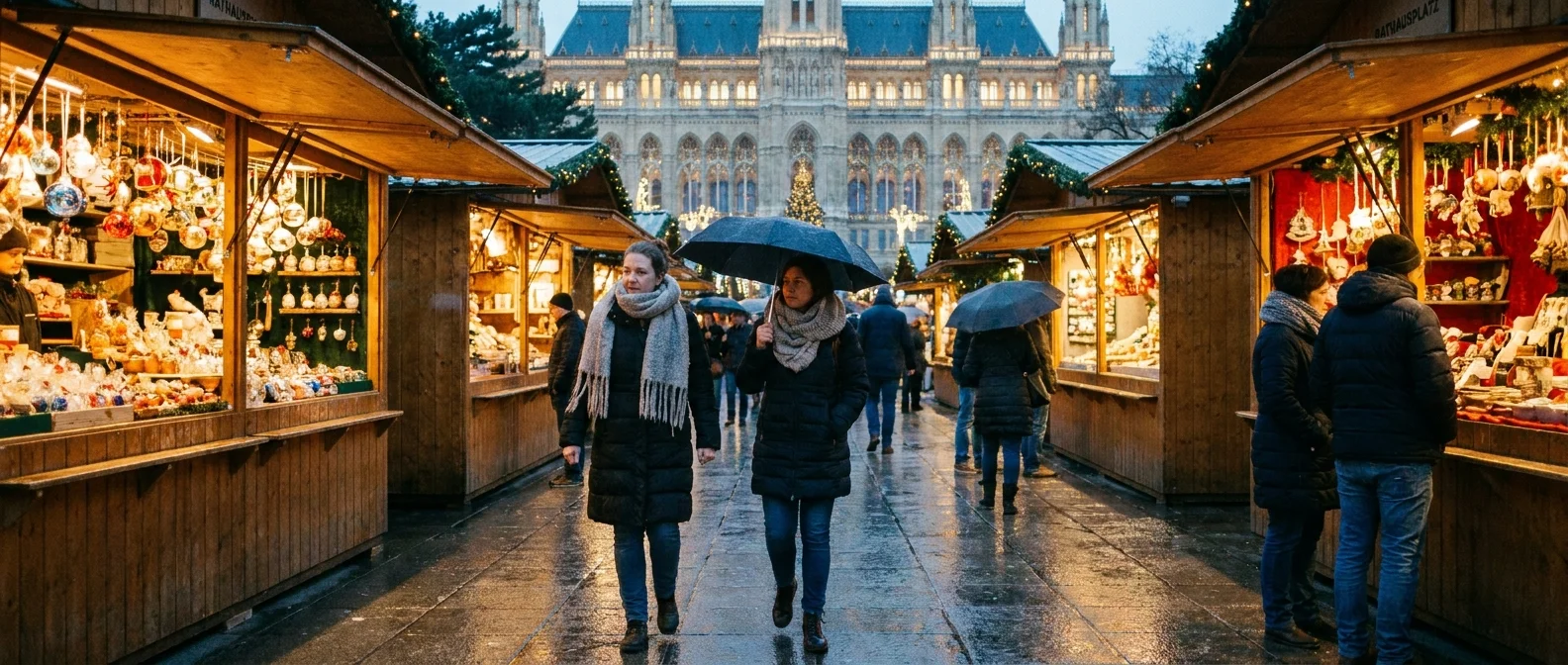
Table Of Contents
Vienna’s “Imperial Advent” creates a sensory masterpiece of twinkling lights, festive decorations, and the irresistible scent of roasted chestnuts, but the damp cold rolling off the Danube requires more than just a heavy coat. If you are planning a Vienna Winter trip and a Vienna Christmas market itinerary, you may wonder how to stay warm enough to enjoy the markets for hours without looking like a polar explorer. This guide provides a practical blueprint for preparing for Vienna’s winter weather, managing sharp temperature changes, and navigating the U-Bahn like a local.
You’ll also discover how to choose suitable winter clothing, plan efficient routes between festive markets, and protect your belongings in busy crowds. By preparing for chilly outdoor conditions and warmer indoor attractions, you can explore Vienna’s imperial landmarks, sample seasonal treats, and enjoy its magical Christmas atmosphere without unnecessary discomfort.
Quick Answer
- Best Window: Late November to December 23 for traditional markets; December 27 to January 1 for the New Year’s Eve Trail.
- Expected Conditions: Highs of 1°C to 5°C (34°F to 41°F) with high humidity and “Schnürlregen” (steady drizzle).
- Main Friction: The rapid body temperature drop when transitioning from overheated museums or trams to standing still at outdoor market stalls.
- Booking Note: Reserve State Opera tickets and famous restaurants, such as Figlmüller, at least 3 months in advance.
| Month | Avg. Temp (Day/Night) | Crowd Level | Best For |
|---|---|---|---|
| Late Nov | 6°C / 1°C | Moderate | Early bird shopping: lower hotel rates. |
| December | 3°C / -2°C | Peak | The full “Imperial Advent” experience and lights. |
| Late Dec | 2°C / -3°C | High | The Silvesterpfad (New Year’s Eve Trail) and fireworks. |
| January | 2°C / -4°C | Low | The Ball Season and ice skating at Rathausplatz. |
Book These Vienna Christmas Market Hotels Now.
The 3-Day Vienna Christmas Market Itinerary
To avoid market fatigue, you must categorize your visits by vibe and geography. The Vienna Christmas market itinerary 3-day approach ensures you see the imperial, the bohemian, and the palatial zones without unnecessary transit time.
Day 1: The imperial ring (district 1)
Start at the Rathausplatz, the largest and most commercial market in the city. Arrive by 3:30 PM to see the artisanal crafts before the “Illumination” occurs at 4:15 PM. From there, walk 10 minutes to the Freyung, the city’s oldest market, which specializes in traditional ceramics and glass ornaments.
- Dossier Fact: Sunset occurs between 3:55 PM and 4:10 PM. Seeing the lights kick on is the logistical highlight of the day.
- Food Tip: Grab a Käsekrainer (cheese-filled sausage) from the Bitzinger Würstelstand near the Albertina. It is a local staple that provides the necessary calories for cold-weather walking.
- Keyword: Vienna Christmas market itinerary
Day 2: Bohemian lanes and organic crafts (district 7 and 4)
Head to Spittelberg in the 7th District. These narrow Biedermeier lanes offer a local, artisanal atmosphere that feels distinct from the grand palaces. Later, take the U4 line to Karlsplatz for the “Art Advent.” This is the only market where all products, including the food and drink, are certified organic.
- Dossier Fact: Spittelberg is narrow. Avoid it between 5:00 PM and 8:00 PM if you dislike tight crowds.
- Food Tip: Try the Ofenkartoffel (giant baked potatoes) in Spittelberggasse.
- Keyword: best vienna christmas markets
Day 3: Palatial grandeur and the Ferris wheel (district 3 and 2)
Visit the Belvedere Palace market for a regal backdrop and high-end crafts. In the afternoon, take the U1 or U2 line to Praterstern for the Wintermarkt located under the Riesenrad (Ferris wheel). This is the “Winter Woods” zone, which offers more space and permanent amusement rides.
- Dossier Fact: The Prater offers more space and permanent rides compared to the cramped city center stalls.
- Food Tip: Lángos (deep-fried dough with garlic) is the must-eat here. It is heavy, hot, and ideal for late-night winter energy.
- Keyword: Are Vienna Christmas markets open after Christmas
Vienna Winter Packing List: Mastering the "Bite"
The humidity from the Danube makes 2°C feel significantly colder than the number suggests. Your Vienna winter packing list must prioritize moisture management and security over sheer bulk.
The indoor-outdoor transition
Vienna’s museums, cafes, and trams are aggressively heated, often exceeding 22°C (72°F), while the markets remain near freezing. The secret to comfort is high-denier merino wool thermal base layers. Merino wool regulates temperature and does not add the bulk that makes navigating crowded U-Bahn cars difficult. If you wear heavy cotton, you will sweat indoors and freeze the moment you step back into the wind.
- Dossier Fact: High humidity causes a “bite” that penetrates standard denim. Thermals are non-negotiable for anyone planning to stand still at a market for more than 20 minutes.
- Keyword: vienna winter packing list
Footwear for cobblestones and cold
The historic center is largely cobblestone, which saps heat from the soles of your feet. Wear thick-soled, waterproof boots. Thin soles lead to “frozen toe syndrome” within 30 minutes of standing at a Glühwein stall. When considering what to wear in Vienna in December, remember that “Schnürlregen” (steady drizzle) is more common than snow. Waterproofness is more important than fur lining. Ensure your boots have enough room for thick wool socks without cutting off circulation.
Security in the “bump and grab” zones
While Vienna is statistically very safe, the Rathausplatz and Stephansplatz are prime spots for opportunistic pickpockets during the peak festive season. Use an anti-theft crossbody bag worn under your heavy coat. This keeps your phone and wallet accessible to you but impossible for others to reach in a dense crowd.
- Dossier Fact: The “Bump and Grab” is the most common petty crime at major markets. It usually happens when tourists are distracted by the light displays or holding a mug of punch.
- Keyword: best anti-theft bag for Christmas markets
What to Pack for Tenerife in Winter: The Ultimate List.
Transit Mechanics: Navigating the Grid
Understanding the Vienna U-Bahn travel ticket system is the difference between a seamless trip and a frustrating fine from the “Black Riders” (plainclothes ticket inspectors).
The Vienna City Card vs. VOR Pass
The Vienna City Card (€17 to €29) includes transport and various museum discounts. However, the VOR (Verkehrsverbund Ost-Region) 72-hour ticket (€17.10) is the “insider” choice for pure transport. It covers all trams, buses, and U-Bahn lines within the city limits.
Dossier Fact: Paper tickets must be validated in the blue boxes before* boarding the U-Bahn or immediately upon entering a tram. Failure to validate is treated the same as having no ticket.
- Keyword: vienna winter travel card
The S7 airport secret
Avoid the expensive CAT (City Airport Train), which costs €15 for a one-way trip. The S-Bahn S7 takes only 9 minutes longer, follows the same route to the Wien Mitte station, and costs approximately €4.40. If you already have a 72-hour city pass, you only need to buy a top-up ticket for the “outer zone” for about €2.
- Dossier Fact: If your hotel is near the Hauptbahnhof (Main Station), take the Railjet instead of the S7 or CAT. It is faster and costs the same as the S-Bahn.
- Keyword: vienna u-bahn travel ticket
Digital navigation and battery life
The WienMobil app is the gold standard for tickets and routing. It provides real-time data on tram arrivals and platform changes. However, the cold kills smartphone batteries rapidly. Keep your phone in an internal pocket near your body heat to ensure you are not stranded without your digital ticket. Use touchscreen winter gloves to validate tickets or check maps without exposing skin to sub-zero wind chill. This is a primary factor in how to stay warm at Christmas markets.
Timing, Crowds, and the New Year Transition
Timing your visit is critical to avoid the “Saturday Night Crush” and to understand what happens after the 25th of December.
The “golden hour” strategy
The best time to visit any market is 3:30 PM. You get 30 minutes of daylight to see the craftsmanship of the ornaments, followed by the illumination at 4:15 PM. This allows you to experience the atmosphere before the 5:30 PM post-work crowd arrives.
- Dossier Fact: Tuesday and Wednesday are the quietest days. Saturday nights at Rathausplatz often reach police-enforced capacity, where entry is temporarily paused to prevent overcrowding.
- Keyword: vienna christmas market itinerary
The Silvesterpfad (New Year’s Eve Trail)
If you arrive after Christmas, the city transforms for the Vienna New Year’s Eve Trail. While many smaller markets close on December 23 or 24, the markets at Maria-Theresien-Platz, Schönbrunn, and the Prater transition into “New Year’s Markets” and stay open until early January. The Silvesterpfad itself is a series of stages across the city center offering everything from waltz lessons to pop music on December 31.
- Dossier Fact: Most traditional markets close on Dec 23 or 24, but the “Imperial” markets stay open as Silvester (New Year) markets.
- Keyword: Vienna New Year’s Eve trail
Mistakes First-Timers Make
1. The “Rathausplatz Only” Trap: Many tourists only visit the main market. The consequence is experiencing the highest prices and biggest crowds. The fix is to visit Karlsplatz for organic goods or Altes AKH for a student-driven, local vibe.
2. Buying Single Tickets: Buying a new ticket for every U-Bahn trip is a common error. The consequence is spending double the amount of a 72-hour pass. The fix is to buy a VOR 24, 48, or 72-hour pass immediately upon arrival at the airport or station.
3. The Sunday Myth: Assuming everything is closed on Sunday. The consequence is missing a great sightseeing day. The fix is to realize that while standard shops are closed, all Christmas markets and museums remain open on Sundays.
4. Ignoring the “Pfand”: Walking away from a stall with your mug without returning it. The consequence is losing your €5 deposit. The fix is to return the mug to any stall in that specific market to get your cash back, or keep it as a €5 souvenir.
The Ultimate 7-Day Quiet Tenerife Winter Itinerary.
Related FAQs
The official illumination usually happens around 4:15 PM, coinciding with the early winter sunset. It is best to be at your chosen market by 3:45 PM to see the transition from day to night.
Most markets close by 4:00 PM on December 24. However, the markets at Schönbrunn Palace and Maria-Theresien-Platz remain open on Christmas Day and through the end of the year as New Year’s markets.
Temperatures typically range from -3°C to 5°C. The high humidity from the Danube creates a “wet cold” that feels sharper than dry cold. Wind chill is common on the Ringstrasse, so windproof outer layers are essential.
The U-Bahn (subway) is the most efficient method. It is clean, heated, and runs frequently. For a scenic but warm view, take Tram Line 1 or 2, which circles the Ringstrasse and passes many of the city’s most famous illuminated buildings.
Use an anti-theft crossbody bag worn under your coat. Never put your phone or wallet in your back pocket or the outer pockets of your coat. Be particularly vigilant at the Rathausplatz and Stephansplatz markets where crowds are densest.
It depends on your pace. The Vienna Pass is only cost-effective if you plan to visit at least three high-cost attractions, such as the Hofburg, Schönbrunn, and the Kunsthistorisches Museum. If you are mostly there for the atmosphere and markets, a transport-only VOR pass is a much better value.
Closing
With your thermals packed and your U-Bahn pass ready, you are prepared to navigate the imperial streets of Vienna with ease. Your next step is to download the WienMobil app and map out your first arrival at Rathausplatz during the golden hour. The city is designed for walkers, provided you have the right layers to withstand the Danube’s winter chill.

Blue Lagoon vs Sky Lagoon is an important comparison for travelers who want to experience Iceland’s famous geothermal bathing culture. Stepping into the steaming, mineral-rich waters of an Icelandic geothermal pool while the crisp sub-Arctic air surrounds your shoulders creates a memorable travel experience. Whether you are exploring the rugged Ring Road or seeking essential […]

Oman winter 4×4 road trip planning requires more than just a passing sense of adventure; it demands careful preparation and strategic foresight. The allure of Oman in winter is undeniable, with its cinematic landscapes of frankincense-scented souqs, emerald wadis, and towering canyons offering a refreshing escape from the scorching summer heat. However, exploring this rugged […]
Norwegian fjords autumn cruise offers travelers a chance to experience Norway’s dramatic landscapes during one of the most atmospheric times of the year. As October fades into November, the steely grey waters of the Norwegian Sea reflect snow-dusted peaks, while low-hanging mist creates a mysterious backdrop across the fjords. The quieter season also brings fewer […]