
What Made That Hotel Bed So Comfortable? I Finally Found Out
Disclosure: To help support our website, some of the links below are affiliate links. This means that if you choose to make a purchase, we will earn a commission at no additional cost to you.
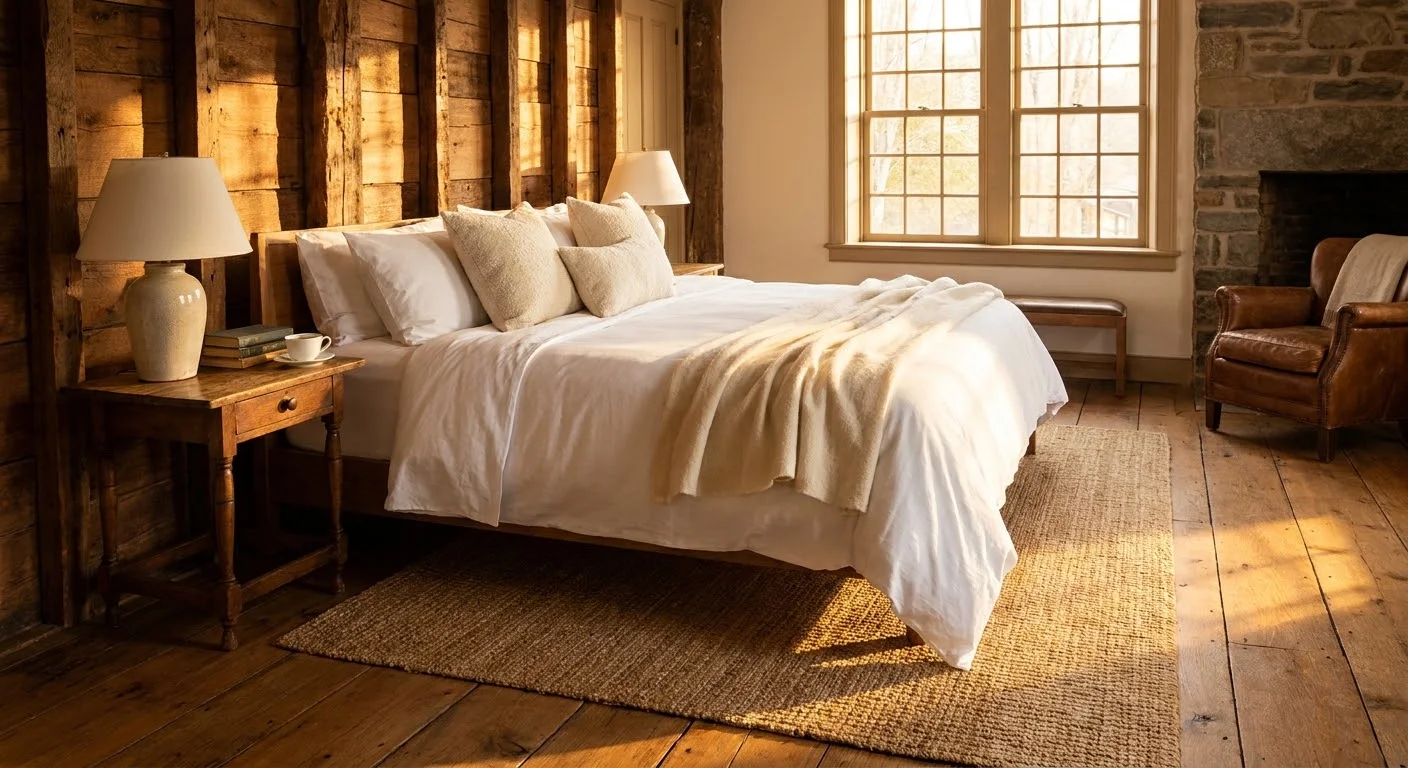
Table Of Contents
- The Awakening
- The Bed-in-a-Box Fallacy
- The Anatomy of a Five-Star Sleep
- The Science of Support & Sensory Luxury
- The Arrival & The Aftermath
- Is it really the same as a hotel bed?
- Saatva Classic Price, Trial and Warranty
- Pros and Cons: What Reviewers and Owners Report
- Who Should Buy the Saatva Classic, and Who Should Skip It
- Mechanical Specifications: Bed-in-a-Box vs. Hospitality Hybrid
- Related FAQs
- Final Verdict
Short answer: The bed I loved in that hotel felt supportive, buoyant and cushioned at the same time, and I traced that feel to a coil-based build with a soft, tailored top. The Saatva Classic is the mattress I chose to recreate it at home. It is a strong pick for back, combination and hot sleepers who want firm, traditional support, but it costs about $1,700–$2,200 for a queen and charges a $99 return fee.
The Awakening
The morning light in the Hudson Valley has a specific, amber quality in late October. It spilled across the wide-plank oak floors of my room at the restored 18th-century farmhouse inn, warming the crisp, heavy percale of the duvet. I lay there for a long time, listening to the distant crunch of gravel in the driveway, waiting for the familiar, dull ache in my lumbar spine to announce itself.
It never came.
For the first time in perhaps three years, I woke up with a spine that felt elongated, weightless, and entirely free of tension. I shifted my weight. The bed responded instantly—a perfect, buoyant suspension that cradled my hips without swallowing them. I found myself doing something entirely undignified for a weekend getaway: I stripped the linens right down to the mattress protector, desperate to uncover the hotel mattress comfort secrets hiding beneath the sheets. My obsession with replicating this five-star sleep experience at home eventually led me to the Saatva Mattress, a revelation in how we approach restorative rest. But in that sun-drenched room, all I knew was that I had been sleeping entirely wrong.
I took a photo of the label tag, ran my hands along the structured, hand-tufted edges, and realized that true comfort isn’t just about softness. It is about architecture.
The Bed-in-a-Box Fallacy
Returning to my Brooklyn apartment felt like a structural downgrade. Waiting for me was my three-year-old “bed-in-a-box”—a dense, rolled-up block of polyurethane foam I had purchased off the internet in a fit of late-night convenience. Not every bed in a box is all foam, and plenty of them sleep well, so this is the story of the one I bought.
When it was new, the foam felt novel, like sinking into a cloud. But foam can degrade over time. Mine compressed under the heaviest parts of my body, namely the pelvis and shoulders, and failed to push back. This creates the dreaded “hammock effect,” forcing the spine into a subtle, unnatural curve for eight hours a night.
Worse still was the thermal reality of dense memory foam. It can act as an insulator, trapping ambient body heat and turning a restorative night’s sleep into a claustrophobic, sweaty ordeal. And then there was the lack of active edge support. Sitting on the side of my foam bed to tie my shoes meant sliding perilously toward the floor, the material collapsing under concentrated weight.
I realized that, at least in the budget bed I bought, modern convenience had sacrificed structural integrity. We traded the enduring, mechanical support of traditional mattress making for the novelty of watching a vacuum-sealed sponge inflate on our bedroom floors. I wanted my Hudson Valley morning back. I wanted a bed built like a piece of fine furniture, not a shipping liability.
I Slept on a Saatva Mattress for Six Months: Here Is My Honest Review.
The Anatomy of a Five-Star Sleep
I began a deep-dive investigation into the engineering of luxury hospitality sleep. I spoke with boutique hoteliers and interior designers, poring over the mechanical specifications of commercial-grade beds. I learned quickly that many luxury hotels do not rely on solid blocks of foam. They favor highly engineered, coil-based hybrid systems.
The secret to that buoyant, weightless feeling is the marriage of deep durability and surface responsiveness. It is a delicate balance of physics and textiles, designed to accommodate a revolving door of guests with entirely different body types and sleep preferences, all without losing structural integrity. The more I researched, the more I suspected that my morning back pain was at least partly a symptom of a worn-out bed. My foam bed was passively absorbing my weight, whereas a well-built coil bed pushes back more firmly, which helps keep the spine closer to neutral alignment.
In my quest to find a true hotel-quality mattress, I learned that the magic lies in the architectural foundation of the bed itself—specifically, the gauge of the steel.
The Saatva Classic uses a dual-stage coil system. According to Saatva’s published specifications, the foundation is built on 13-gauge tempered recycled steel base coils. In the world of wire gauges, a lower number means thicker, more robust steel. This is the workhorse layer, providing the durability meant to prevent sagging over years of use. Above this industrial-strength base sits a layer of 14.5-gauge pocketed micro-coils (884 in a queen). Because these coils are individually wrapped, they move independently of one another. They provide localized, responsive contouring that cradles the hips and shoulders and reduces motion transfer when a partner turns over, although coil beds still pass along more motion than memory foam does.
The Science of Support & Sensory Luxury
Bridging the gap between firm support and tactile, high-end luxury requires more than just good springs. It requires targeted design.
The most interesting discovery in my research was Saatva’s Lumbar Zone® technology, which Saatva describes as patented. In the Saatva Classic, firmer coils, active spinal wire, and tighter quilting are concentrated in the center third of the mattress, where your lower back rests. Saatva says the design is meant to help keep the spine in neutral alignment, and reviewers note that it carries an endorsement from the Congress of Chiropractic State Associations. That is not the same as clinical proof that it treats back pain, so treat it as thoughtful design, not medicine. It is, however, exactly the kind of targeted support I had been missing.
Then comes the “Goldilocks” standard of hospitality: the calibration of firmness. Many hotels aim for a medium to medium-firm feel, and Saatva’s Luxury Firm option sits at about 6 out of 10. That tension provides the resistance needed to support the spine while offering enough give to cushion the joints, which suits most side, back, and combination sleepers. Heavier stomach sleepers should look at the Saatva HD instead.
When to Book Kyoto Hotels for Sakura Season 2027.
But the mechanics must be cloaked in sensory luxury. The tactile surface of a five-star bed is a masterclass in textile layering. Instead of a standard pillow top that is merely sewn onto the mattress edges, the Saatva Classic has a 3-inch Euro pillow top covered in organic cotton. The padding is inserted beneath the outer cover, creating a cleaner, more tailored look and a top layer designed not to shift or lose its shape.
You will see hand-tufting mentioned on many luxury beds. It is a labor-intensive process of running heavy cords through the mattress to keep the layers from shifting. According to Saatva, that applies to the Saatva HD’s pillow top, while the Classic’s pillow top is quilted.
Finally, the organic cotton cover is treated with Guardin®, a botanical antimicrobial finish that Saatva says inhibits bacteria, mold,d and mildew, appealing to anyone who values a clean sleep environment.
I Ignored Mattress Quality for Years. My Back Finally Changed My Mind.
The Arrival & The Aftermath
When I finally made the decision to upgrade my sleep architecture, the contrast in the delivery experience was jarring—in the best possible way.
Three years ago, I had wrestled a heavy, off-gassing cardboard box into my elevator, dragged it down the hall, and sliced open the plastic wrap, waiting 48 hours for the chemical odor to dissipate and the foam to expand. It was an undignified process for an underwhelming product.
True luxury, I realized, cannot be vacuum-sealed, crushed into a cardboard box, and left on a damp porch. High-tensile steel and a structured Euro top must be delivered intact. My new bed arrived via white-glove uncompressed delivery. Two professionals brought the mattress into my bedroom exactly as it was built—pristine, fully formed, and ready for immediate sleep. They set it up on my frame and carried away my old, sagging foam block, leaving nothing behind but a beautifully tailored centerpiece for my bedroom.
That first night, slipping beneath the duvet, I felt the familiar, buoyant suspension I had experienced in the Hudson Valley. The micro-coils contoured instantly to my shoulders, while the Lumbar Zone® technology held my lower back in a state of weightless neutrality. The organic cotton breathed, remaining cool and crisp throughout the night.
Investing in our sleep architecture is, perhaps, the ultimate form of self-care. We spend a third of our lives in bed; it should not be a place of compromise. By understanding the mechanics of hospitality-grade comfort, I was able to bring the luxury of travel into my everyday life. I no longer wake up waiting for the ache in my spine. I just wake up, rested.
This is my experience, and results differ from person to person. A mattress is not a medical treatment. If back pain persists, follows an injury, or comes with numbness, weakness, fever, or bladder or bowel changes, see a doctor.
Saatva Classic vs DreamCloud: Why Spending More Gets You So Much More.
Is it really the same as a hotel bed?
Not entirely, and it is worth being honest about that. Experts who have studied hotel beds say the comfort comes from several things working together: a medium-to-medium-firm mattress that suits most guests, layered bedding, a topper, a choice of pillows, larger beds, and regular upkeep. A mattress gets you the foundation, but the sheets, pillows, and bedroom still matter.
Saatva Classic Price, Trial and Warranty
| Spec | What you get |
|---|---|
| Price (queen) | List price: about $2,100–$2,230, with sales often $1,700–$1,830 |
| Sleep trial | 365 nights |
| Warranty | Lifetime |
| Return or exchange fee | $99 |
| Delivery | Free white-glove delivery and setup, with optional old-mattress removal |
| Firmness options | Plush Soft, Luxury Firm, Firm |
| Heights | 11.5 or 14.5 inches |
| Weight capacity | Reported as 600 lbs |
Prices and policies change often. Check Saatva’s official site before you buy.
Pros and Cons: What Reviewers and Owners Report
What works well
- Strong support and stable edges, praised by most reviewers.
- Breathable, good for hot sleepers.
- Three firmness options and two heights.
- White-glove delivery and a 365-night trial.
What to watch
- The $99 return or exchange fee. The trial is long, but sending the bed back still costs $99.
- Price. It is a premium purchase even on sale.
- Sagging reports. Lab testers rarely see early sagging, but some owners report body impressions over time. The warranty reportedly covers sags of about 1.5 inches or deeper. A protector, a proper foundation, and rotation help.
- Motion transfer. Coil hybrids are less motion-isolating than memory foam.
- Too firm for some side sleepers. Lighter side sleepers often prefer Plush Soft.
- Weight. It is heavy to rotate without help.
Who Should Buy the Saatva Classic, and Who Should Skip It
Buy it if you: like a traditional, supportive hotel-style bed, sleep on your back or combine positions, weigh 130 lbs or more, sleep warm, or want white-glove delivery and a long trial.
Skip it if you: are a light side sleeper who loves a memory-foam hug, share a bed with a very light sleeper, are on a tight budget, or do not want any risk of a $99 return fee.
Mechanical Specifications: Bed-in-a-Box vs. Hospitality Hybrid
| Feature | Typical bed-in-a-box foam | Saatva Classic |
|---|---|---|
| Core Support | Dense polyurethane foam | 13-gauge tempered steel base coils |
| Comfort Layer | Memory foam, which can trap heat | 14.5-gauge pocketed micro-coils |
| Lumbar Support | Uniform density, which can sag | Lumbar Zone® coils, spinal wire and quilting |
| Edge Support | Often minimal | Foam rail around the coils |
| Top Layer | Synthetic zip-off cover | 3-inch Euro pillow top with organic cotton cover |
| Delivery Method | Vacuum-sealed in a cardboard box | White-glove uncompressed delivery |
Not every bed in a box is all foam. Many are hybrids, so compare the specific model you are considering.
Book These Vienna Christmas Market Hotels Now.
Related FAQs
Solid blocks of polyurethane and memory foam can act as insulators. They rely on your body heat to soften and contour, and they can trap that heat in the process. Coil-based hybrid beds allow more airflow, and organic cotton covers are breathable, although designs vary and modern foams often include cooling features.
In Saatva’s lineup, Luxury Firm is the medium-firm option, roughly 6 out of 10 on the firmness scale. It offers enough cushioning to relieve pressure on the hips and shoulders and a structural core that supports the spine. Some reviewers found their test models firmer, and firmness feels different depending on your weight and sleep position.
Hand-tufting is a traditional technique in which heavy cords are passed through the mattress to bind the layers together and help prevent shifting and bunching. Saatva says the Saatva HD’s pillow top is hand-tufted, while the Classic’s pillow top is quilted. No tufting technique guarantees a bed will feel the same years later, so check the warranty terms as well.
Yes. A standard pillow top is an extra layer of padding sewn onto the top of the mattress, which can flatten and separate over time. A Euro pillow top is inserted beneath the outer cover, creating a flush, tailored edge designed to keep its shape.
For back, combination, and hot sleepers who want firm, traditional support, many reviewers say yes. It is less compelling for light side sleepers, budget shoppers, or anyone who wants to avoid the $99 return fee.
There is a 365-night trial. If you return the mattress, you get a refund minus a $99 fee. Check Saatva’s official page for current terms, including any minimum-night rule.
Some owners report body impressions over time, although lab testers rarely see them early on. The lifetime warranty reportedly covers sags of about 1.5 inches or deeper, and a proper foundation helps.
Several reviewers report good lower-back support, but results vary, and a mattress is not a medical treatment. Research on mattresses is limited, although one major trial found a medium-firm mattress did better than a firm one for chronic low back pain. See a doctor if pain persists.
Hotels combine a broadly appealing medium-firm mattress with layered bedding, toppers, several pillow options, larger beds, and regular upkeep. Experts say personal preference matters as much as price.
It is built in a luxury hotel style, with coils, a Euro pillow top, and an organic cotton cover. That does not mean any specific hotel uses it.
Final Verdict
After tracing that Hudson Valley morning back to its source, the answer is less mysterious than it first felt. A great hotel bed is not magic. It is structure: a supportive coil system underneath, a medium-firm feel that works for most bodies, a cushioned top that stays tailored, and the right sheets and pillows on top.
For me, the Saatva Classic recreated that structure at home. Two coil layers, Lumbar Zone® support in the center third, and a 3-inch Euro pillow top gave me the buoyant, supported feel I had been chasing, and white-glove delivery made the upgrade painless. In my experience, it was a clear improvement over the sagging, heat-trapping foam bed it replaced.
It is not perfect. At roughly $1,700–$2,200 for a queen,n it is a premium purchase;e, the $99 return fee is real; some owners report sagging over time, and lighter side sleepers may find the firmer options harsh. It also will not replace good pillows, breathable bedding, and a cool, dark bedroom.
My advice: if you want firm, traditional, hotel-style support and can afford it, the Saatva Classic is one of the safer premium choices, especially during a sale. Pick Luxury Firm if you are an average-weight back, side, or combination sleeper, choose Plush Soft if you are lighter and sleep on your side, and use the 365-night trial. Track how you feel each morning for a month, and keep the bed only if your mornings improve. If back pain persists, treat that as a reason to talk to a doctor, not just to buy a new mattress.
We spend about a third of our lives in bed. It is worth getting right.

Short answer: The bed I loved in that hotel felt supportive, buoyant and cushioned at the same time, and I traced that feel to a coil-based build with a soft, tailored top. The Saatva Classic is the mattress I chose to recreate it at home. It is a strong pick for back, combination and hot […]

The Shetland Islands in late January are not for the faint of heart. At Scotland’s rugged northern edge, long winter nights, freezing temperatures, and powerful North Sea winds create a dramatic setting for one of Europe’s most remarkable cultural celebrations. Yet, travelers who brave these challenging conditions can experience an unforgettable spectacle filled with local […]

The White Lotus Phuket trend has transformed Thailand’s winter travel scene, driving demand for ultra-luxury stays and exclusive marine experiences. For travelers visiting between December 2026 and March 2027, the biggest question is where to find secluded turquoise waters and enjoy them before peak-season crowds arrive. This guide covers the essential details of Phuket island […]