
Book These Vienna Christmas Market Hotels Now
Disclosure: To help support our website, some of the links below are affiliate links. This means that if you choose to make a purchase, we will earn a commission at no additional cost to you.
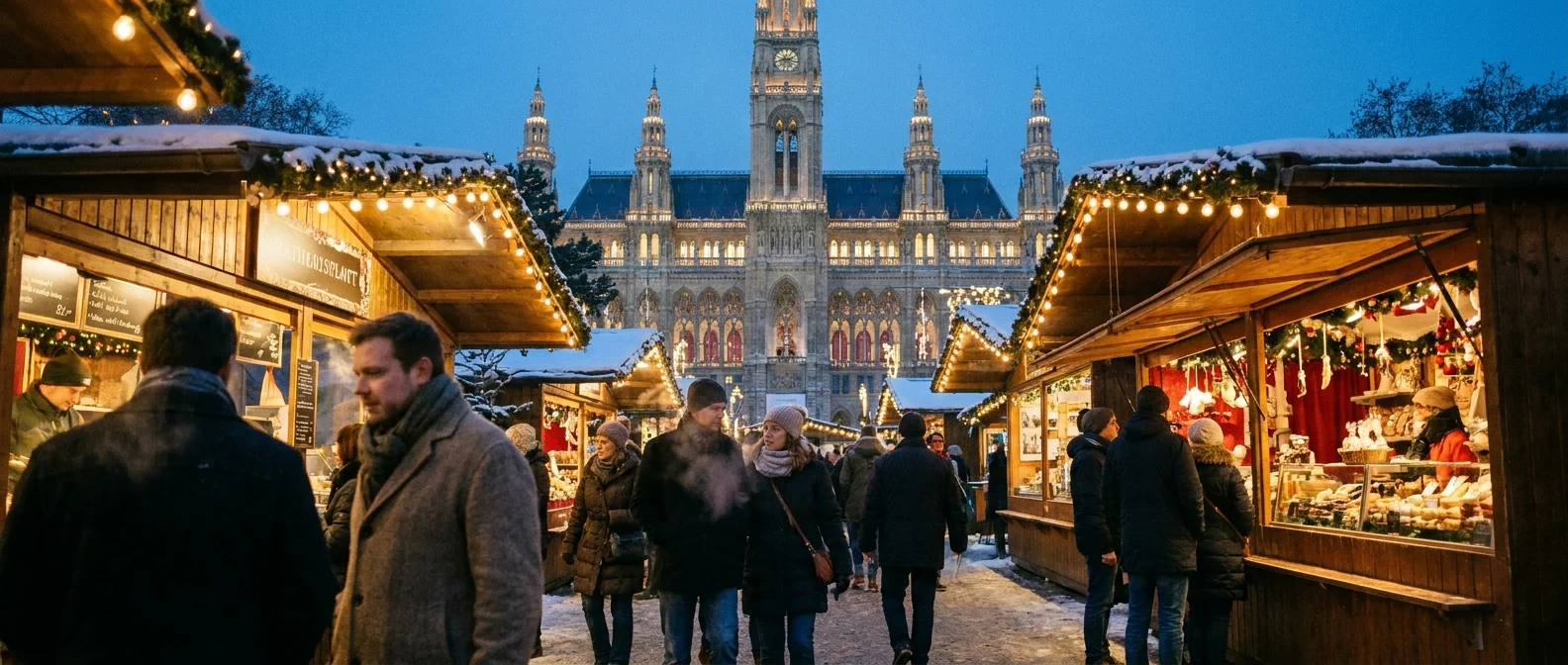
Table Of Contents
- Quick Answer
- The "inventory cliff": where to stay in vienna for christmas markets
- Navigating the "big three": Rathausplatz, Maria-Theresien-Platz, and Belvedere
- Transit Mechanics and the Vienna Travel Card Guide
- Weather, Wardrobe, and the "Wiener Wind"
- Money, Etiquette, and the "Pfand" System
- Mistakes First-Timers Make
- Related FAQs
The inventory cliff in Vienna is a common concern during the festive season, as demand for centrally located accommodation rises sharply before the Christmas markets open. If you are planning a trip for November or December 2026, the key question is not just where to stay, but how to find Vienna Christmas Market Hotels that offer good value, convenient transport connections, and easy access to the city’s festive attractions. This guide explains how to compare accommodation in prestigious District 1 with more budget-friendly options in nearby districts, where direct U-Bahn connections make it easy to reach Vienna’s most iconic Christmas markets.
Vienna rewards travelers who plan. In mid-November, the city transforms into a festive destination filled with sparkling lights, traditional market stalls, seasonal treats, and historic squares dressed for Christmas. Because many major attractions sit relatively close to the city center, demand for Vienna Christmas Market Hotels can increase significantly during peak dates. To plan a smooth and affordable trip, you should understand Vienna’s district layout, compare hotel locations, and check public transport connections before booking. Staying outside the immediate city center can help you manage accommodation costs without sacrificing access to the festivities. With the right location and planning, you can enjoy Vienna’s Christmas markets while keeping your travel budget under control.
Quick Answer
- The Booking Window: Secure your room by early October to avoid the 70% inventory drop-off.
- Best Time to Visit: November 15 to 30 offers lower rates and full market access with fewer crowds.
- The Main Friction: The Wiener Wind makes 2°C feel like -5°C: windproof layers are non-negotiable.
- Top Logistics Tip: Skip the CAT train: the S7 S-Bahn is a fraction of the cost and nearly as fast.
| Month | Avg Daytime Temp | Crowd Level | Best For |
|---|---|---|---|
| Mid-November | 7°C (45°F) | Moderate | Lower hotel rates and local atmosphere |
| Early December | 4°C (39°F) | High | Peak festive lights and full event calendar |
| Mid-December | 2°C (36°F) | Very High | Maximum Christmas atmosphere (highest prices) |
| Dec 24–26 | 3°C (37°F) | Moderate | Quiet streets: note many markets close Dec 23/26 |
The "inventory cliff": where to stay in vienna for christmas markets
The geography of Vienna is organized in concentric circles. District 1, known as the Innere Stadt, is the historic core enclosed by the Ringstraße. Staying in Vienna Innere Stadt hotels puts you within a five-minute walk of the Rathausplatz, the Freyung, and the Am Hof markets. However, this convenience comes with a specific set of trade-offs. Rooms in District 1 during the peak weeks of December are often 40% more expensive than identical quality rooms just two blocks outside the Ring. Furthermore, the narrow streets of the old city act as acoustic chambers: if your hotel is near a major thoroughfare like the Graben or Kärntner Straße, expect significant noise from crowds and delivery vehicles until late in the evening.
For travelers seeking a more authentic experience, the District 7 alternative is often superior. Neubau and the Spittelberg area offer a boho atmosphere characterized by Biedermeier architecture and narrow cobblestone lanes. Spittelberg hosts its own market that is popular with locals for its artisanal crafts and lack of mass-produced souvenirs. Staying here places you a 10-minute walk from the Museumsquartier and the Maria-Theresien-Platz markets. The hotels in this district are frequently converted townhouses that offer more square footage than the cramped historic rooms of District 1.
If budget is a primary concern, focus on District 9, also known as Alsergrund. This is the university quarter, located just north of the Rathaus. It offers several affordable hotels near Vienna’s Christmas markets that cater to a younger, academic demographic. The logistics are simple: Tram Lines 37, 38, and 40 run directly from the heart of Alsergrund to the Schottentor station on the Ringstraße in under 10 minutes. This allows you to stay in a quiet, residential neighborhood while maintaining a commute that is shorter than a walk across the city center.
Secondary district value can also be found in District 2 (Leopoldstadt) and District 4 (Wieden). District 4 is particularly strategic for those who want to be near the Karlsplatz Art Advent market. Hotels in Wieden often have 20 to 30% lower rates than District 1 with identical transit times to the city center via the U1 or U4 U-Bahn lines. When researching where to stay in Vienna for Christmas markets, prioritize proximity to a U-Bahn station over a District 1 zip code. A hotel next to the U1 Taubstummengasse station (District 4) is functionally closer to the city center than a hotel on the far eastern edge of District 1.
Navigating the "big three": Rathausplatz, Maria-Theresien-Platz, and Belvedere
The Rathausplatz market is the tourist epicenter of the city. It is the largest, the brightest, and the most crowded. If you have booked hotels near Rathausplatz in Vienna, you have the advantage of visiting during the off-peak hours. The best strategy for Rathausplatz is to visit between 11:00 AM and 1:00 PM. During this window, the tour bus surges have not yet arrived, and you can photograph the stalls and the neo-Gothic City Hall without significant obstruction. Avoid Saturday nights at Rathausplatz entirely: the area becomes impassable, and the wait times for food can exceed 30 minutes.
For a more sophisticated experience, look toward the Belvedere. Hotels near Belvedere Vienna offer access to a market that focuses heavily on high-quality Austrian design and gourmet food products. The backdrop of the Upper Belvedere Palace provides a scale that the smaller city markets cannot match. To maximize your time here, arrive at the nearby Schönbrunn Palace market at 10:00 AM sharp. This is the only way to beat the massive influx of tour groups that arrive by 11:30 AM. After exploring Schönbrunn, take the U4 line back toward the center and walk to the Belvedere for the afternoon light.
Culinary highlights at these markets are specific and regional. At Rathausplatz, the Kaiserschmarrn (shredded pancakes with plum compote) is the standard. At the Karlsplatz Art Advent, the focus is on organic certified products: seek out the Raclette Brot, which is thick sourdough bread topped with melted alpine cheese and pickles. This is a heavy, practical meal designed for people spending hours outdoors in sub-zero temperatures.
The best time to visit Vienna Christmas markets for photography is during the “Grand Illumination.” Daylight in Vienna fades rapidly by 4:00 PM in December. Plan your Vienna Christmas walking tours to begin at 3:30 PM. This timing allows you to see the architectural details of the Ringstraße buildings in the blue hour before the festive lights take full effect. By 4:30 PM, the city is fully illuminated, and the atmosphere shifts from a commercial market to a social festival.
Transit Mechanics and the Vienna Travel Card Guide
The first mistake most visitors make happens at the airport. The City Airport Train (CAT) is heavily marketed as the premium way to reach the city. It costs €15 for a single trip. However, the S7 S-Bahn follows a nearly identical route, reaches the same destination (Wien Mitte) in 25 minutes, and costs only €4.40. If you have already purchased a city transit pass, the S7 fare is even lower, as you only need to pay for the single zone outside the city limits.
This Vienna travel card guide recommends the standard Wiener Linien 24-, 48-, or 72-hour pass. These passes cost between €8 and €17 and cover all trams, buses, and U-Bahn trains within the city. Do not be tempted by the “Vienna City Card” unless you are a heavy museum visitor. The City Card includes discounts for attractions, but for the average traveler focused on Christmas markets, the standard transit pass is more cost-effective.
Efficiency in Vienna is built on the U-Bahn system. When booking, prioritize Vienna hotels with direct U-Bahn access on the U1, U2, or U4 lines.
- The U1 (Red Line) connects the main train station (Hauptbahnhof) to Stephansplatz and the Prater.
- The U2 (Purple Line) serves the Museumsquartier and the Rathaus area.
- The U4 (Green Line) is essential for reaching Schönbrunn Palace and the Naschmarkt.
Etiquette on the transit system is strictly enforced by social pressure. On escalators, the rule is “Stand on the right, walk on the left.” Blocking the left side is considered a significant breach of local norms. Furthermore, Vienna operates on an honor system with no turnstiles. However, you must validate paper tickets in the blue boxes located at the entrance of the station before you board. Plainclothes inspectors frequently patrol the lines, and the fine for an unvalidated ticket is approximately €105, payable on the spot.
Weather, Wardrobe, and the "Wiener Wind"
The temperature in Vienna during December is deceptive. While thermometers usually show between 2°C and 7°C, the high humidity from the Danube and the “Wiener Wind” tunnel effect through the narrow alleys of District 1 make it feel significantly colder. This wind can be biting, especially when standing still at a market stall for an hour.
When considering what to wear to Vienna Christmas markets, think in terms of technical layers rather than heavy fashion coats. A windproof outer shell is more important than a thick wool overcoat that allows the wind to pass through the weave. High denier thermal base layers, preferably merino wool, are essential. For footwear, do not wear sneakers or thin-soled boots. The 19th-century cobblestones are cold and often damp. You will likely walk 15,000 steps or more per day: insulated, waterproof walking boots with lug soles are the only practical choice.
Cold weather also presents a challenge for electronics. The combination of low temperatures and constant GPS use for market hopping will drain modern smartphone batteries in 3 to 4 hours. To prevent this, keep your phone in an inner pocket close to your body heat and carry a high-capacity power bank. If your phone dies, navigating the winding streets of the Spittelberg or the Alsergrund becomes difficult after dark.
Accessibility is another weather-related factor. While the U-Bahn stations are almost all equipped with elevators, the markets themselves can be challenging. The Spittelberg market, with its narrow lanes and uneven stones, is notoriously difficult for strollers and wheelchairs during peak evening hours. If you have mobility concerns, the Maria-Theresienplatz and Rathausplatz markets are much more spacious and offer flatter terrain.
Money, Etiquette, and the "Pfand" System
Despite the modernization of Vienna’s retail sector, the Christmas markets remain heavily cash-reliant. While some larger stalls at Rathausplatz have begun accepting cards, the majority of food and drink vendors are cash only. This is primarily for speed: the evening rush does not allow for the processing time of card transactions. Carry a dedicated coin purse and plenty of small bills (€5 and €10 notes).
The most important financial mechanic to understand is the Pfand, or mug deposit. When you order Glühwein (mulled wine) or Punsch, you will be charged a deposit for the mug, usually between €3 and €5. This is in addition to the price of the drink. You have two options: return the mug to any stall in that specific market to reclaim your cash, or keep the mug as a souvenir. Each market has a different mug design every year, and many travelers collect them. Note that you cannot return a mug from the Belvedere market to a stall at Rathausplatz.
The Sunday Rule is a logistical hurdle for self-directed travelers. Almost all supermarkets, pharmacies, and retail shops in Vienna are closed on Sundays. Only restaurants, cafes, and the Christmas markets remain open. If you are staying in an apartment and need groceries, you must purchase them by Saturday evening. The only exceptions are the small “Gourmet” markets located inside major train stations like Wien Mitte or Hauptbahnhof, which remain open on Sundays but with limited stock and higher prices.
Tipping protocol in Vienna is different from the North American model. Do not leave cash on the table and walk away. When the server brings the bill, you should round up the total and tell them the amount you wish to pay as you hand over your cash or card. For example, if the bill is €18.20, you might say “Twenty” or “Stimmt so” (it is correct) as you hand over a €20 note. A tip of 5 to 10% is standard and appreciated, but it is handled as a verbal transaction at the moment of payment.
Mistakes First-Timers Make
The CAT Trap is the most common financial error. Paying €15 for the City Airport Train when the S7 S-Bahn is already covered by your transit pass (or costs only €4.40) is an unnecessary expense. The time difference is negligible: usually less than 10 minutes.
The Sunday Starvation is a reality for those who do not plan. Forgetting that supermarkets close on Sundays can leave you with no breakfast options if you are staying in an Airbnb. Always stock your kitchen by Saturday afternoon.
The “Central” Myth leads travelers to pay 40% more for a room in District 1. These rooms are often noisier and smaller than those in District 4 or District 9. In a city as well connected as Vienna, being “central” is a relative term. If you are within 300 meters of a U-Bahn station, you are effectively central.
The Market End-Date Assumption is a frequent cause of disappointment. Many travelers assume the markets run until New Year’s Eve. In reality, most major markets, including the large one at Rathausplatz, close on December 23rd or 26th. If you arrive on December 27th expecting the full Christmas experience, you will find many stalls being dismantled.
Related FAQs
Most major markets, including Rathausplatz and Spittelberg, are scheduled to open the weekend of November 13 to 15, 2026. Smaller neighborhood markets may open a few days later.
November is superior for budget travelers and those who dislike heavy crowds. All markets are fully operational by the third week of November, but hotel rates have not yet reached their December peak, and the “Inventory Cliff” is less of a factor for late November dates.
The Rathausplatz market typically stays open until December 26th. The Maria-Theresien-Platz market and the market at Schönbrunn Palace often transition into “New Year’s Markets” and remain open through the first week of January.
Generally no. While some large stalls are adapting, the majority of food and drink vendors remain cash-only to maintain speed during the evening rush. Always have €5 and €10 notes ready.
The Karlsplatz Art Advent is the top choice for families. It features a large straw-filled play area, farm animals, and a human-powered carousel, offering a break from the more alcohol focused atmosphere of the larger markets.
Expect daytime highs of 2°C to 7°C (35°F to 45°F). However, the dampness and the wind coming off the Danube make it feel significantly colder. Full winter gear, including thermals and windproof layers, is required for anyone planning to spend more than an hour outdoors.
With the October inventory cliff approaching, the most critical step for your 2026 holiday is securing your room in a transit-connected district like Wieden or Alsergrund today. Once your base is booked, you can focus on the finer details of your winter itinerary, knowing you have bypassed the highest price spikes of the season.

The arrival of mid-November in the United Kingdom transforms medieval streets and historic squares into glowing festive destinations filled with Christmas markets, sparkling lights, and seasonal attractions. For travelers, the challenge is not just choosing where to go but securing advance rail fares and centrally located hotels before December demand pushes prices higher. The main […]
The inventory cliff in Vienna is a common concern during the festive season, as demand for centrally located accommodation rises sharply before the Christmas markets open. If you are planning a trip for November or December 2026, the key question is not just where to stay, but how to find Vienna Christmas Market Hotels that […]
The 2027 cherry blossom season in Kyoto will attract travelers from around the world, making early accommodation planning essential. As demand rises, standard room rates can increase sharply, and popular hotels may sell out months before the blossoms reach their peak. This guide answers the most important question for spring visitors: when should you book […]