
Tour de France Mountain Stage Logistics: Campervan Spots, Closures & Spectator Tips
Disclosure: To help support our website, some of the links below are affiliate links. This means that if you choose to make a purchase, we will earn a commission at no additional cost to you.
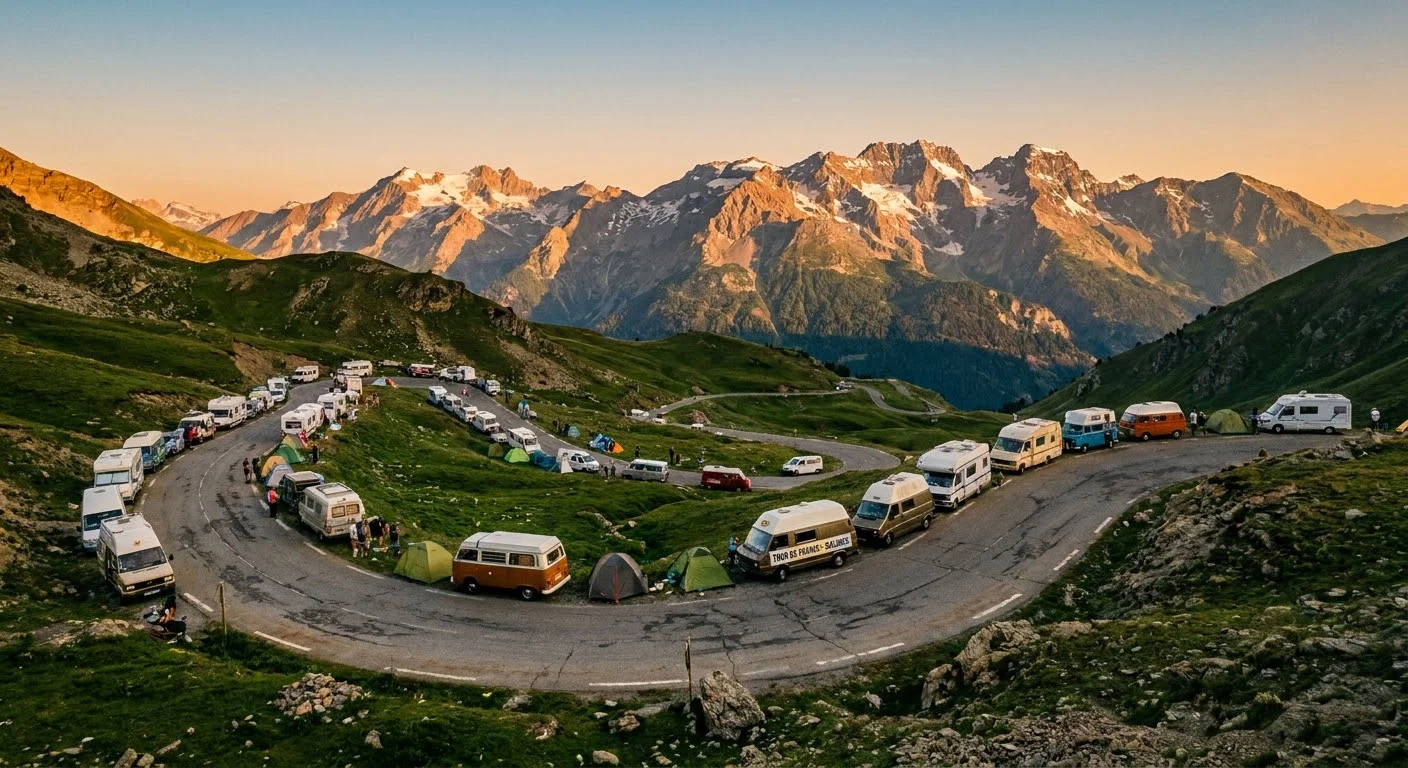
Table Of Contents
- Decoding the Mountain: Road Closures and Access Rules
- The Art of the Alpine Campervan: Positioning and Boondocking
- Strategic Positioning: Securing Your Vantage Point
- Surviving the Summits: Weather, Gear, and Etiquette
- Regional Basecamps and Transit Strategies
- Related FAQs
- The Final Descent: A Reflective Conclusion
Tour de France spectator planning requires far more than simply showing up on race day. There is no sporting arena in the world quite like the high mountains of the Tour de France. Every July, the jagged peaks of the French Alps and the steep, unforgiving passes of the Pyrenees transform into a sprawling, multi-day festival of cycling, culture, and alpine adventure. However, witnessing the peloton battle up legendary ascents like the Col du Galibier or Alpe d’Huez takes careful preparation. The infrastructure of these remote mountain passes temporarily struggles with the sheer volume of fans, making meticulous planning essential. When preparing for a bucket-list trip to witness the world’s greatest cycling race, relying on insider travel guides and destination inspiration helps you navigate complex logistics, road closures, and campervan positioning for a smooth spectator experience.
For those ready to brave the elements and the crowds, the reward is unparalleled. Here is your ultimate operational manual for conquering the mountain stages of the Tour de France.
Wimbledon Public Queue Guide: What to Bring, Overnight Camping Rules & Tickets.
Decoding the Mountain: Road Closures and Access Rules
Watching a mountain stage is a masterclass in patience and timing. Unlike a traditional stadium event, the venue is a living, breathing alpine ecosystem temporarily commandeered by the race. Understanding how and when the mountain locks down is the first step to a successful trip.
The 48-Hour Rule: The French Gendarmerie (national police) typically closes major mountain passes, known as Cols, to motorized traffic 24 to 48 hours before the race arrives. If you plan to drive a car or campervan up the mountain, you must beat this deadline.
Reading the Signs: Travelers must be prepared to read local municipal signs, known as Arrêtés Préfectoraux. These temporary notices are posted at the base of the climbs and dictate the exact Route Barrée (Road Closed) timelines. Do not rely solely on GPS apps, as they often fail to reflect real-time Gendarmerie barricades.
Bicycle and Pedestrian Access: Even after the roads close to cars and motorhomes, cyclists and hikers can usually ascend the mountain. This access typically remains open until two to four hours before the Publicity Caravan arrives, at which point the road is entirely cleared.
The Great Descent: Once the Voiture Balai (the infamous broom wagon) passes, signaling the absolute end of the race, do not expect a quick exit. It can take three to five hours for the Gendarmerie to safely reopen the road and clear the vehicular gridlock. Pack extra snacks, open a bottle of local wine, and embrace the post-race camaraderie.
The Art of the Alpine Campervan: Positioning and Boondocking
For many, renting a motorhome (camping-car) is the quintessential way to experience the Tour de France. But parking a seven-meter vehicle on the side of a sheer mountain drop-off requires strategy, nerve, and a deep understanding of local etiquette.
- The “Verge” Culture: There are no official campsites on the side of a high mountain pass. Spectators park their rented campervans on the grassy verges or gravel pull-outs alongside the tarmac. To secure a spot on a marquee climb like the Col du Tourmalet or Mont Ventoux, you must arrive three to four days in advance.
- Absolute Self-Sufficiency: You are boondocking in the truest sense of the word. There is no water, electricity, or waste disposal on the mountain. Travelers must arrive with full fresh-water tanks, empty grey and black water cassettes, and enough food to last a minimum of four days.
- The White Line Rule: The Gendarmerie are incredibly strict regarding road safety. Your vehicle must be parked completely behind the solid white line of the road. If a side mirror, awning, or bumper protrudes into the roadway, the police will force you to move, and you will likely lose your spot entirely.
- Leveling Ramps: Mountain roads are inherently steep and uneven. Heavy-duty leveling ramps (chocks) are an absolute necessity. Without them, your campervan refrigerator will fail to function properly, and sleeping at a 15-degree angle will quickly ruin the experience.
Oman Winter Road Trip Logistics: 4×4 Rental, Camping Gear & Oasis Itinerary.
Strategic Positioning: Securing Your Vantage Point
Finding the perfect spot on a 20-kilometer climb is an art form. The most coveted locations are the steep hairpin bends (lacets), where the riders slow down to a grueling pace, allowing spectators a longer, more intimate view of the action. However, claiming these prime locations requires arriving days in advance and understanding the specific flow of the event.
Similar to the meticulous route planning required when looking up a Bridgwater Carnival 2026 viewing guide to secure the best vantage point for a massive parade, positioning yourself on a Tour de France mountain stage means analyzing the route map, anticipating crowd density, and staking your claim early. Look for spots with a clear line of sight down the mountain. Avoid the outside of fast, sweeping corners; safety barriers may obstruct your view here, and they pose a higher risk if a rider loses control during a descent. Instead, look for elevated grassy banks on the inside of a curve where you can safely look down onto the peloton.
Surviving the Summits: Weather, Gear, and Etiquette
The high mountains are notoriously unpredictable. While the valleys might feel like a summer holiday, the summits belong to a completely different climate zone.
- The Alpine Microclimate: July in valley towns like Bourg d’Oisans or Tarbes can reach a blistering 35°C (95°F). Yet, at 2,000 meters (6,500 feet), temperatures can plummet to near freezing, often accompanied by violent, sudden afternoon thunderstorms.
- Layering Strategy: Dress in smart, modular layers. Start with moisture-wicking merino wool base layers. Add a packable down jacket or heavy fleece for the chilly morning waiting hours, and always carry a high-quality, seam-sealed Gore-Tex rain shell.
- Sun Protection: The UV index at high altitudes is brutal, and shade is virtually nonexistent above the tree line. Wide-brimmed hats, SPF 50+ sunscreen, and polarized sunglasses are mandatory.
- The Publicity Caravan: Passing roughly two hours before the riders, this 15-kilometer-long parade of sponsor floats throws free merchandise (casquettes, keychains, snacks) to the crowd. It is a beloved cultural phenomenon. Tip: Keep children well back from the road edge, as the floats travel surprisingly fast.
- Respecting the Riders and the Mountain: When the cyclists arrive, never run alongside them. Keep dogs on short leashes, ensure flags do not hang into the roadway, and never use smoke flares, which blind the riders and disrupt their breathing. Finally, remember that these mountains are protected national parks (such as the Parc National des Pyrénées). Spectators must pack out all trash, leaving no trace behind.
What to Pack for Patagonia in Shoulder Season: Windproof Layering & Trekking Gear.
Regional Basecamps and Transit Strategies
If you aren’t sleeping on the mountain in a campervan, establishing a strategic basecamp in a valley town is your best alternative. From these hubs, you can rent a road bike or e-bike and cycle up the mountain on the morning of the race, entirely bypassing the vehicular road closures.
Basecamp Comparison Guide
| Region | Premier Basecamp Towns | Best For Accessing | Optimal Transit Strategy |
|---|---|---|---|
| The French Alps | Bourg d’Oisans, Briançon | Alpe d’Huez, Col du Galibier, Col d’Izoard | Rent an e-bike or road bike in town; cycle up the closed roads on race morning. |
| The Pyrenees | Lourdes, Pau, Bagnères-de-Luchon | Col du Tourmalet, Col de Peyresourde, Hautacam | Utilize TGV train access to Pau/Lourdes; rent a car to drive to the base of the climbs early. |
| Provence | Bédoin, Malaucène | Mont Ventoux (The Giant of Provence) | Stay in a local gîte; walk or cycle through the forest trails to reach the mid-mountain chalets. |
Related FAQs
No. The Tour de France is entirely free to watch along the roadside. The only ticketed areas are the VIP hospitality grandstands located strictly at the start and finish lines of the stages.
Yes! This is one of the greatest joys of the Tour. Amateur cyclists can ride the exact route on the morning of the race, usually until the Gendarmerie clear the road for the Publicity Caravan (about two to four hours before the race arrives).
Cellular reception is highly unreliable on remote cols, especially when tens of thousands of fans overload the local cell towers. Bring a portable FM radio to listen to Radio Tour broadcasts, and download all maps and translation apps offline before leaving the valley.
If you do not have a campervan, you must rely on nature, as public facilities are nonexistent on the high passes. Because these are protected alpine environments, you must follow Leave No Trace principles, bury human waste deep in the soil, and pack out all toilet paper in sealed bags.
The Final Descent: A Reflective Conclusion
Attending a mountain stage of the Tour de France is an exercise in endurance, much like the race itself. It demands days of preparation, a willingness to brave the elements, and the patience to navigate the logistical labyrinth of the high Alps and Pyrenees. You will likely be cold, sunburned, and exhausted all in the span of a single afternoon.
Yet, when the distant thumping of television helicopters echoes through the valley, and the roar of the crowd swells as the peloton rounds the final hairpin bend, every ounce of effort is instantly validated. You are no longer just a spectator; you are a vital part of the world’s most magnificent traveling amphitheater. Plan meticulously, respect the mountains, and prepare for an unforgettable alpine adventure that will linger in your memory long after the final rider has crossed the finish line.

Australian Open travel and spectator planning involves more than simply booking tickets and reserving a hotel. The Australian Open is far more than the first Grand Slam of the calendar year; it is a two-week cultural festival that transforms Melbourne into a global sporting destination. Every January, the city becomes an energetic hub of elite […]
Tour de France spectator planning requires far more than simply showing up on race day. There is no sporting arena in the world quite like the high mountains of the Tour de France. Every July, the jagged peaks of the French Alps and the steep, unforgiving passes of the Pyrenees transform into a sprawling, multi-day […]
Wimbledon queue guide: overnight camping helps tennis fans prepare for one of the most unique traditions in the sporting world. Every year, tennis enthusiasts, eager travelers, and local visitors head to Wimbledon Park, pitch their tents, and spend the night hoping to secure coveted tickets to the All England Lawn Tennis Club. Understanding the Queue […]